Social Anthropology - Robots, AI & Society
Affichage des articles dont le libellé est Colloque. Afficher tous les articles

mardi 10 mars 2026

Towards a Symbiotic Society with Humans and AI


This event aims to open an interdisciplinary space for dialogue around the notion of symbiosis between humans and intelligent technologies, by examining the current and future forms of coexistence between people, machines, and artificial intelligence systems within society. Machines and AI systems have taken on an increasingly proactive role in our living environments. They are no longer confined to industrial or production contexts, but are now embedded in everyday life, extending into fundamental domains such as education, health and medicine, therapeutic support, creativity, artistic and cultural practices, as well as systems of belief. In these contexts, technologies no longer merely execute actions but participate in complex relational dynamics: they accompany, suggest, stimulate, and support human activity, while continuously adapting through interaction with human practices. This evolution gives rise to processes of co-adaptation in which humans and machines progressively align their modes of action and interaction. The goal of this event is to explore the conditions under which such relationships can become genuinely symbiotic, understood as positive, sustainable, and desirable forms of coexistence. By bringing together perspectives from neuroscience, robotics, anthropology, medicine, the arts, and the humanities, the event seeks to reflect on how forms of human–technology coexistence can be conceived and constructed in ways that support, rather than constrain, the societies of the future.

Watch on YouTube : https://youtu.be/fQv85vVllZo?si=6bD-ToGLI06Gt7Ow

mercredi 25 février 2026

Séminaire de la FHU BREATH : "Nouveaux regards sur le souffle"


Séminaire de la FHU BREATH 

Nouveaux regards sur le souffle

*

Hôpital de la Pitié Salpetrière

Bâtiment Gosset

*

Jeudi 26 mars 2026

Inscription obligatoire en suivant ce lien

*

Objectifs : Enrichir et stimuler la réflexion interdisciplinaire et faire émerger des axes et projets de recherche communs autour du souffle, de la souffrance respiratoire et de l’innovation clinique, scientifique, technologique et artistique.

*

Programme

9h00 : Accueil & Café de bienvenue

9h30 - 10h15 : Ouverture de la journée et présentation de la FHU BREATH (Laure Serresse)

10h15 - 11h : Conférence sur l’invisibilité de la dyspnée (Thomas Similowski)

11h - 11h15 : Pause-café

11h15 - 12h30 : Conférence sur les facteurs humains en santé (Mr Christian Morel)

12h30-14h : Buffet déjeunatoire

14h-16h : Ateliers participatifs "Cartographier les questions de recherche"

  • Neurosciences et dyspnée (animé par Nathalie Nion et Liane Schmidt)
  • Art et Souffle (animé par Claire Attali et Joffrey Becker)
  • Médecine palliative et Souffrance respiratoire (animé par Adrien Evin et François Chaumier)

16h-17h : Restitution collective en plénière

17h-17h30 : Clôture prospective 

mercredi 6 août 2025

Robots for Humans - Ro-Man Workshop


Robots for Humans

Empowerment Through Co-Creative and Social Robots!

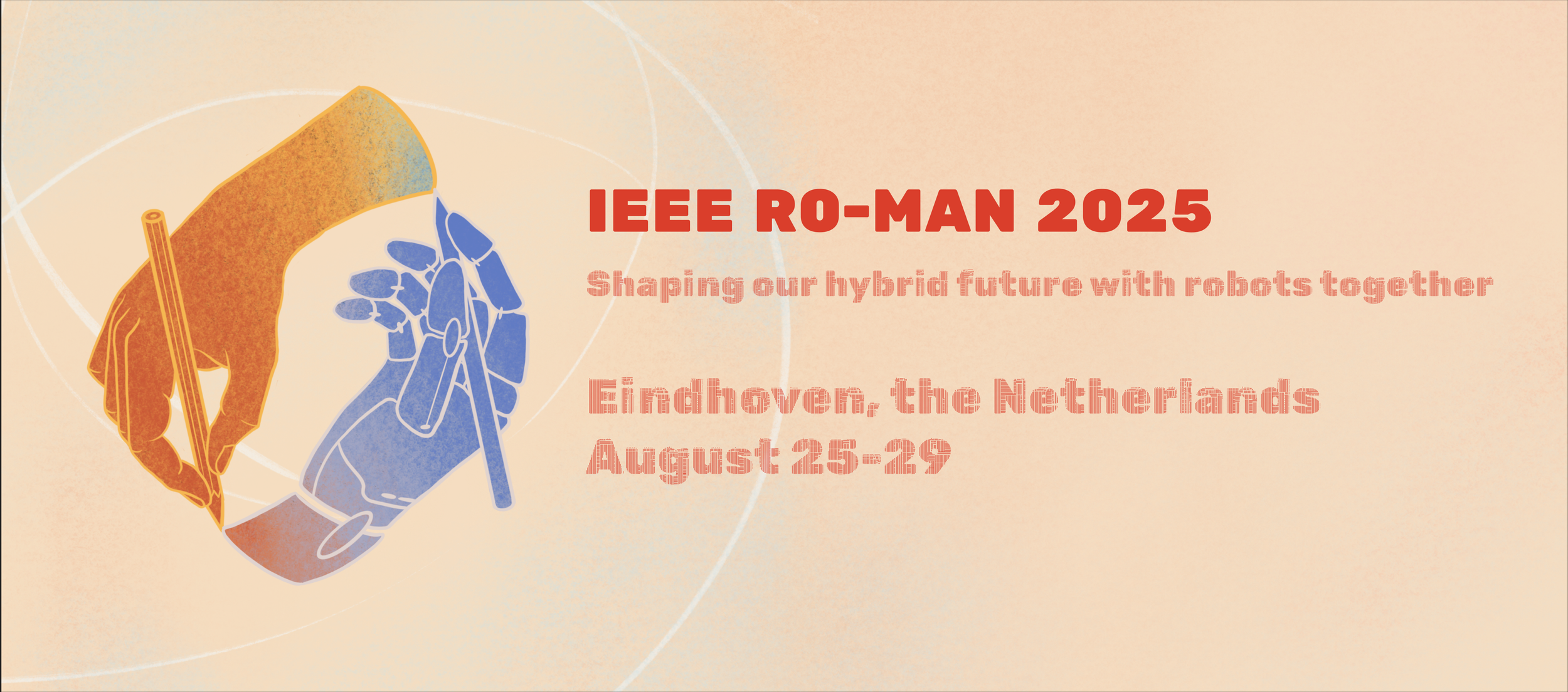
RO-MAN 2025 August 29, 2025 / Eindhoven, The Netherlands

The promise of having personal social robots in people’s everyday lives brings a technological, but also sociological, transformation. Researchers need to address complex technical challenges to allow co-robots to autonomously experience people’s environments and interact accordingly. Moreover, different issues have to be addressed as well regarding the role that such co-robots will take on in every aspect of human life. For instance, what makes these machines social? And is their perception as social agents desirable? What dimensions and scales of social life do they cover? Particularly, we are interested in exploring the social robots’ role of empowerment for people.

For example, how can social robots empower humans by augmenting rather than replacing human creativity? This hands-on workshop invites participants to explore new concepts in HRI, looking at the role of social robots in creative domains. The full-day program includes expert keynote speakers, participant poster sessions, and a dynamic co-creative design sprint. Together, we’ll explore timely challenges and opportunities, such as the lack of design guidelines for empowerment and the potential of social robots in creative collaboration. Through an interactive co-creative design sprint, we will engage in a structured process of mapping, sketching, storyboarding, (experiential) prototyping, and discussion.

The workshop offers the opportunity to experiment, connect, and shape the future of HRI to researchers, designers, artists, and developers. Desired outcomes cover social robotics in the direction of designing robots for empowerment and co-creativity, insights into how HRI design choices affect the interaction, socialness, and outcomes on empowerment, and co-creativity. The workshop will conclude with a panel discussion to synthesize findings and discuss general issues related to the role and perception of social robots, working towards guidelines for the design of social robots for creative empowerment.

The edition of the workshop is jointly organized with other two workshops.

Topics of interests include but are not limited to:

  • The role of (mini-c) creativity in the context of “everyday” HRI
  • The design of human-robot interactions in art settings
  • Social robots for creativity support
  • Designing for human-robot co-creativity
  • The design of robots with (verbal and non-verbal) social capabilities
  • The evaluation of socialness perception in human-robot interactions
  • The study of the relationship between human-likeness and socialness
  • The application of theoretical principles in applied robotics research
  • Design principles for empowerment and inclusion
  • Robot adaptive application for marginalised groups
  • Involvement of stakeholders’ perspective in design and implementation
  • AI and LLM application to empower and co-creation in HRI

dimanche 1 juin 2025

International Conference on Child-Robot Interaction - CRI25


Organized by the University of Milano-Bicocca, INDIRE, Università Politecnica delle Marche, and Fondazione Bambini Bicocca, CRI25 will feature research contributions on child-robot interaction, with a focus on methodologies, technologies, psycho-pedagogical applications, and the ethical, philosophical, social, and cultural dimensions of this growing field.

Keynote Speakers : Joffrey Becker, Andrea Blasco, Lorenzo Cesaretti & Shaun Gallagher

jeudi 20 mars 2025

International Conference “Cultures of Research”


The international conference “Cultures of Research” takes stock of the first four years of the fellow program at the Käte Hamburger Kolleg: Cultures of Rearch (c:o/re). During these years, more than fifty international fellows came to the KHK c:o/re to explore the transformation of research in its many facets. Topics such as the digitalization of science, the growing influence of AI on research practices, the organizational transformations in science, the “engineering of science”, and the historical as well as intercultural comparison of “varieties of science” have been widely discussed. The conference “Cultures of Research” will focus the discussions on these topics in various panels with current and alumni fellows as well as members of the scientific advisory board of the KHK c:o/re.

https://khk.rwth-aachen.de/event/international-conference-cultures-of-research/

mardi 15 octobre 2024

ROBOTS BORDEAUX 2024 - 18-19 oct. 2024

Selon la Fédération Internationale de Robotique, près de 4 millions de robots industriels seraient actifs fin 2022, essentiellement en Asie. 67 % des entreprises chinoises et 41 % des entreprises françaises anticipent une réduction de leur force de travail en lien avec la robotique. Frey et Osborne (2013) ont estimé que la moitié des emplois aux États-Unis pourraient disparaître en vingt ans. Des effets sur les emplois sont interrogés par la recherche comme les bouleversements des routines et des rythmes de travail, les impacts sur la santé des travailleurs, la modification possible des rapports de prescriptions au sein de l’entreprise ou l’impact du développement de la robotique sur l’environnement. Du secteur de la santé à celui de l’enseignement/recherche, en passant par le domaine militaire ou l’agriculture, tous les domaines sont touchés par ce développement de la robotique. Ainsi, au-delà de ces questions liées au travail, le développement des robots dans la société parce qu’il modifie les normes et valeurs culturelles pose de nombreuses autres questions éthiques, ce qui a permis à un champ à part entière de voir le jour, la roboéthique (Veruggio, 2006). Des questions éthiques, liées à l'interaction entre les robots et les êtres humains, ou à la responsabilité, l’apprentissage, l’évaluation, la prise de décision, les émotions seront interrogées lors de ce colloque.

Avec Gianmarco Veruggio, Sylvie Michel, Johanna Seibt, Murielle Benejat, Catherine Tessier, Joffrey Becker, Roland Lenain, Ouiddad Labbani-I, Jean-Pierre Da Costa, Camille Auger & Nathalie Toulon.

lundi 23 septembre 2024

Journée d'étude RE:24


RE:24

Journée d'étude organisée par

Joffrey Becker, Lilyana Petrova & Syd Reynal

Dans le cadre de la chaire Artss

Jeudi 17 oct. 2024

ENSEA- CURIUM

6 avenue du Ponceau

95000 Cergy

Inscription obligatoire sur :

https://forms.gle/eg8VQK7gThW3vNqX9

La journée d'étude RE:24 cherche à construire un dialogue interdisciplinaire autour de questions situées à l'interface de l'environnement, des sciences et des techniques, de la société et des représentations. Elle vise à explorer de nouvelles manières de faire et de produire des savoirs, en portant l'intérêt sur les rapports entre arts et science, sur la conception d'objets techniques sobres, soutenables, socialement et culturellement pertinents, mais aussi sur l'expérimentation de nouvelles modalités de l'écriture scientifique. L'ambition est d'engager des échanges autour de questions technologiques et épistémologiques à l’interface de disciplines issues autant des sciences et techniques de l’ingénieur que des sciences humaines et sociales.

Programme

9h-9h30 Accueil

9h30-10h15

Joffrey Becker

ETIS UMR8051 / CY Cergy Paris Université, ENSEA, CNRS

Épistémologies en reconfiguration

10h15-11h

Sophie Sakka

Grhapes EA7287 / INSHEA

Robotique et société

11h-11h45

Alexandre Pitti & Arnaud Blanchard

ETIS UMR8051 / CY Cergy Paris Université, ENSEA, CNRS

Les enjeux de la sobriété en robotique

12h-14h Pause

14h-14h45

Lilyana Petrova & Syd Reynal

ETIS UMR8051 / CY Cergy Paris Université, ENSEA, CNRS

Des performances-pirates en conférence pour reconfigurer la production des savoirs

14h45-15h30

Antoine Henry

Gériico ULR4073 / Université de Lille

Une approche par l’équité pour rééquilibrer les relations entre artistes et plateformes

15h30-16h Pause

16h-16h45

José Halloy

LIED UMR8236 / Université Paris Cité

Quelles places pour les robots dans les écosystèmes ?

16h45-17h Conclusion


mercredi 6 septembre 2023

Colloque LaborIA : Les transformations du travail par l’IA

mar. 26 sept. 2023 

08:30 - 16:30

Atelier Barillet

15 square Vergennes 75015 Paris

*

Parce quʼelle permet de réaliser des opérations cognitives, de prendre des décisions, de mimer la communication humaine, de manier dʼautres outils et objets et surtout dʼapprendre par elle-même, lʼintelligence artificielle (IA) est vectrice dʼinterrogations sociétales croissantes. Son développement rapide nourrit des craintes politiques et sociales qui portent tant sur lʼévolution des métiers que sur la disparition de certaines fonctions, alimentant des scénarios contrastés (Frey et Osborne, 2017 ; Askenazy & Bach, 2019) et parfois pessimistes sur lʼavenir du travail. Loin dʼêtre réductible à sa seule dimension technologique, lʼIA porte ainsi en elle de profondes mutations sociales : un tiers des emplois pourraient en être transformés ces vingt prochaines années (OCDE, 2016), ce qui en fait un momentum ethnologique (Ferguson et Pecoste, 2022).

Depuis les années 1990, des chercheurs en sociologie du travail, en psychologie sociale et en sciences de gestion se sont intéressés à ces transformations au fil de leurs apparitions (Dodier, 1995 ; Boltanski et Chiapello, 1999 ; Gilbert, 1998...). Progressivement, ils ont offert des cadres dʼanalyse pour appréhender lʼimpact des outils sur les systèmes organisationnels et gestionnaires, les rapports de pouvoir en entreprise, analysant les phénomènes de résistance au changement, lʼévolution des approches RH, managériales ou encore les nouvelles logiques de gestion des compétences (Zimmermann, 2000, 2011 ; Boussard, 2008 ; Chiapello et Gilbert, 2013 ; Meda et Vendramin, 2013).

Cette armature conceptuelle apparaît toutefois à revisiter aujourdʼhui au vu de la profondeur des transformations induites par lʼIA dans les organisations : ces outils ne peuvent désormais plus être considérés comme de simples instruments, et les humains comme seuls “acteurs”. Ces “nouveaux actants” (Latour et al., 2006) et ces articulations Homme-Machine inédites peuvent impacter les systèmes organisationnels et humains (Relieu et Velkovska, 2021 ; Zouinar, 2020). Ils déplacent subtilement les équilibres existants en termes de responsabilité, de reconnaissance, dʼautonomie, de savoir-faire et de relations sociales au travail (Ferguson et Pecoste, 2022). Dans ce contexte, lʼentremêlement des dynamiques pose un défi sociologique nouveau : isoler les impacts spécifiques à lʼIA par rapport

aux enjeux plus généraux dʼappropriation des nouvelles technologies et d'appropriation au changement. Dʼores et déjà, un certain nombre de travaux pointe les enjeux et les risques sociaux potentiellement associés à la conception et à lʼincorporation dans le travail de ces systèmes fondés sur lʼIA (Casilli, 2019 ; Rosa, 2010).

Dans une perspective sociotechnique, qualifier les effets de lʼIA sur le travail représente toutefois un exercice difficile appelant à lʼhumilité collective tant ces technologies sont évolutives - les IA génératives telles que ChatGPT lʼillustrent bien - et comme les rétroactions entre lʼhumain et les outils quʼil façonne sont complexes. Les conséquences des IA sur les organisations, les métiers, les espaces et temps de travail, les besoins en compétences, et plus profondément, les pratiques et relations professionnelles, demeurent peu prévisibles.

Peu de travaux portent aujourdʼhui sur la dimension micro de ces transformations, à lʼéchelle des individus, sur les vécus, les pratiques professionnelles et leurs conséquences sociales et organisationnelles. Il est apparu essentiel dʼengager une étude de lʼexpérience travailleur (Anact, 2018). Faisant le constat du faible nombre de travaux empiriques sur ce thème, une vaste démarche de recherche-action a été impulsée en 2020 par le Ministère du Travail, du Plein emploi et de lʼinsertion et par Inria : LaborIA. A la fois un laboratoire de sciences humaines appliquées et espace dʼanticipation et de réflexion pour lʼaction, LaborIA étudie au concret les transformations alors que se déploient les systèmes dʼIA dans les organisations (LaborIA, 2022 ; 2023). Mobilisant plusieurs équipes de recherche, elle sʼappuie sur un grand nombre dʼétudes de cas.

*

Programme

MATINÉE

COLLOQUE SCIENTIFIQUE

8h30 - 9h00 ACCUEIL

9h00 - 9h15 MOT DʼOUVERTURE par les partenaires du LaborIA (Ministère du

Travail, du Plein emploi et de lʼInsertion, Inria, Matrice) 

9h15 - 9h45 INTRODUCTION par le Keynote speaker 

• Pascal Picq, Paléoanthropologue, maître de conférence au Collège de France

9h50 - 10h50 PANEL 1 : Présentation des résultats du LaborIA Explorer, première zone dʼexpérimentation du LaborIA

• Simon Borel, sociologue, chercheur du LaborIA Explorer, Matrice • Jean Condé, sociologue, Directeur scientifique de Matrice

• Yann Ferguson, Coordinateur scientifique du LaborIA

10h50 - 11h05 PITCHS DES POSTERS de chercheurs travaillant sur différentes problématiques autour des impacts de lʼIA sur le travail

• Louis Devillaine, Doctorant - IA et systèmes techniques complexes, PACTE (CNRS & UGA) & chaire éthique et IA

• Quentin Genissel, Doctorant - Management algorithmique, Université Paris Dauphine PSL

• Valentin Goujon, Doctorant - Deep learning, Médialab Sciences Po • Tanguy Mercier, Ingénieur, Matrice

11h05 - 11h20 PAUSE

11h20 - 12h40 PANEL 2 : Les transformations du travail au niveau de lʼindividu • Modérateur : Marie Benedetto-Meyer, sociologue, Dares

• Gérald Gaglio, Sociologue des organisations, Université Côte d'Azur

• Clément Le Ludec, Chercheur en sociologie du travail, Institut Polytechnique de Paris

• Claire Marzo, Maître de conférence en Droit Public, Université Paris-Est Créteil

PANEL 3 : Les transformations du travail au niveau du collectif, de lʼorganisation

• Modérateur : Moustafa Zouinar, ergonome, Orange Labs

• Joffrey Becker, Anthropologue social, ENSEA-ETIS

• Anca Boboc, Sociologue du travail, Orange Labs

• Emmanuelle Mazuyer, Directrice de recherche en droit, CNRS, coordinatrice du projet TraPlaNum

12h40 - 13h40 DÉJEUNER (buffet) et café


APRÈS-MIDI

DESIGN PROSPECTIF

13h40 - 15h40 CONFÉRENCES INTERACTIVES

Nous penserons les transformations du travail liées à lʼIA, à horizon 2035, sous lʼangle de 3 thématiques déterminantes pour les transformations potentielles. Chaque thématique sera contextualisée par un expert qui partagera les différents éléments essentiels pour pouvoir construire des scénarios.

Dans un second temps, le public sera invité à se positionner sur les scénarios présentés.

• Conférence introductive “Les IA génératives” (30 min) - Bertrand Braunschweig, Coordonnateur scientifique du programme confiance.ai

• Thématique 1 : Droit du travail (30 min) - Claire Marzo, Maître de conférence en Droit Public, Université Paris-Est Créteil

• Thématique 2 : Géopolitique (30 min) - Julien Nocetti, chercheur, programme Géopolitique des technologies, Ifri

• Thématique 3 : Climat (30 min) - Association Latitudes

15h30 - 16h10 PANEL de clôture

• Pascal Picq, Paléoanthropologue, maître de conférence au Collège de France • Yann Ferguson, Sociologue et Responsable scientifique du LaborIA

16h10 - 16h30 CONCLUSION : Perspective socio-historique

• François-Xavier Petit, Historien et Directeur général de Matrice

16h30 CLÔTURE du colloque


vendredi 24 mars 2023

Drôles d'Objets 2023 - Inscriptions ouvertes


Drôles d'objets 

Un nouvel art de faire

Nancy

15 - 17 mai 2023

En association avec le festival Musique Action du CCAM/Scène nationale de Vandœuvre

*

Les inscriptions sont ouvertes jusqu'au 1er mai.

Tarif des inscriptions :

Chercheurs et enseignants chercheurs : 50€

Étudiants : 15€

Les frais d'inscription incluent les déjeuners des mardi et mercredi et l'apéro dînatoire.

Lien : https://drolesdobjets23.sciencesconf.org


mardi 1 novembre 2022

Colloque L'humain qui vient


L'humain qui vient

16, 17 et 18 novembre 2022 

UNESCO, Paris

Pour célébrer la Journée mondiale de la philosophie 2022, Le Fresnoy — Studio national des arts contemporains et l’UNESCO organisent, en partenariat avec Les Rencontres philosophiques de Monaco, du 16 au 18 novembre 2022, au siège de l’UNESCO, à Paris, un colloque et une exposition sur le thème «L'humain qui vient».

Dans un monde hyper-technologisé, le concept même d'humanité est en constante évolution. Qu'appelons-nous humain aujourd'hui ? Que continuons-nous d’appeler humain malgré l'évolution historique évidente et l'avenir incertain auquel nous sommes confrontés ? Assistons-nous à une transfiguration si radicale que sa propre définition, en plus de l'horizon humaniste, est dépassée ? Comment envisager les nouvelles figures de l'humain à venir ?

Qu’appelons-nous aujourd’hui l’humain ?

L’« humain » aura toujours été défini à partir de son évolution et de son devenir historique propre. Mais notre contemporanéité lui aura-t-elle infligé un bouleversement tel qu’il, l’« humain », déborde et dépasse son devenir historique lui-même ? Autrement dit, nous tenons-nous aujourd’hui devant une métamorphose, un « point d’inflexion », où l’« humain » se voit radicalement transformé et porté vers un autre que lui-même – tout autre que la définition, la détermination, l’identité déployées dans et par son histoire propre ? Assistons-nous aujourd’hui à une transfiguration telle que la distinction traditionnelle entre l’être et le devenir de l’humanité se voit résolument surpassée ? La figure de « l’humain qui vient » excède-t-elle – et en quel sens ? – la détermination essentialiste et humaniste de l’humain ? Et plus en avant, comment se confronter aujourd’hui à cette figure inédite de l’humain qui vient ? D’ailleurs, n’aurons-nous pas affaire à une multiplicité de figures de l’humain qui viennent ?

C’est là une exigence à la fois politique et philosophique, certains y ajouteraient un devoir éthique : penser en direction de ces manifestations inédites de l’humain et ainsi des humanités. Depuis quel lieu et à partir de quelle loi pouvons-nous incarner cette exigence philosophique et politique ? Comment cette profonde altération de l’humain modifiera-t-elle notre pensée et quelles seront les conséquences politiques de cette mutation dans l’histoire de l’humanité ? Ces questions philosophiques, politiques, éthiques sont également centrales aux travaux d’artistes, de cinéastes et d’architectes. Leurs approches différentes, leur façon singulière de penser en images, et de réfléchir les lieux et les espaces de l’expérience, ouvrent un regard complémentaire sur notre contemporanité.

Il a paru capital, sur une question aussi importante, de rassembler un ensemble de champs variés de la connaissance, afin d’apporter un éclairage multi-disciplinaire et multiculturel, une dimension que l’UNESCO pouvait idéalement favoriser.

EXPOSITION

Pendant toute la durée du colloque, une exposition sera présentée en salle Mirő, elle rassemblera les oeuvres photographiques de Hugo Deverchère, Stéphanie Roland et SMITH, ainsi que les films de Moufouli Bello, Emanuele Coccia, Fernando Colin Roque, Bianca Dacosta, Nicolas Gourault, Louis Henderson, OV, Momoko Seto, Hadrien Tequi, Yuyan Wang, Agata Wieczorek, produits par Le Fresnoy – Studio national des arts contemporains.

Télécharger le programme du colloque

vendredi 21 octobre 2022

Journées Psyphine 2022


Mercredi 30 novembre 2022 – Jeudi 1er décembre

MSH Lorraine
Salle internationale (324)
91 avenue de la Libération
Nancy

Nous sommes de plus en plus souvent invités à entrer en relation avec des robots ou des machines, que ce soit à des fins pratiques (thérapeutiques, professionnelles, scientifiques) ou ludiques. Au-delà de l’usage fonctionnel, de l’action mécanique et de nos réactions automatiques, nous sommes enclins à entrer dans d’apparentes interactions avec ces machines. Ces interactions sont-elles authentiques ou simulées ? Comment tentons-nous d’interpréter leur comportement ? Devons-nous l’interpréter pour interagir ?

L’objectif des Journées Psyphine est de croiser les regards, les méthodologies et les disciplines afin d’analyser et discuter ces questions.

Entrée libre – Inscription obligatoire

*

Programme

Mercredi 30 novembre

14h - Accueil

14h30 - Guillaume Nassau.
De « l’équipement informatique » à la « sale bête »
Une étude du statut du robot au sein de rencontres humain-machine.

15h30 - Pierre Saint Germier.
Le corps des programmes au prisme de l’improvisation musicale.

16h30 - Pause

17h00 - Sophie Sakka.
Robotique & Société.

18h00 - Fin

Jeudi 1er décembre

10h00 - Joffrey Becker & Séverine Lagneaux.
Vivre dans une boucle
Ethnographie visuelle des routines dans une exploitation laitière robotisée.

11h00 - Pause

11h30 – Hugo Scurto.
L’intra-action des machines apprenantes.

12h30 - Pause déjeuner

14h00 - Jessica Colombel.
Mouvement biologique et Interaction Humain-Robot

15h00 - 16h30. Discussion générale

Soutiens : AHP-PReST, Atilf, Inria, InterPsy, Loria, MSH Lorraine, Université de Lorraine.


dimanche 28 août 2022

Ethnographies of Outer Space

Ethnographies of Outer Space 
Methodological Opportunities and Experiments
1 September 2022 - 2 September 2022
Palazzo di Sociologia - Via Verdi 26, Trento
Italy

Keynote speakers 
Stefan Helmreich (Massachusetts Institute of Technology)
Zara Mirmalek (NASA, Bay Area Environmental Research Institute) 
Valerie Olson (University of California, Irvine)

An Anthropologist on Mars (1995) is a well-known book by the neurophysiologist Oliver Sacks. Contrary to what its title suggests, the book is neither about anthropology nor about the Red Planet. It is, in fact, a collection of seven essays on the paradoxical circumstances in which those affected by particular neurological conditions find themselves. Still, the juxtaposition of the words “anthropology” and “Mars” conveys a sense of inaccessibility that – for a long time – was familiar to the ethnographer approaching fields of inquiry related to space science and technology: rather like the protagonists in Sacks seven tales, the social sciences and the humanities were (often implicitly) deemed unfit to travel to such unimaginable lands, purportedly devoid of any sociality or humanness. 
Only in the early 2000s a number of seminal studies broke through the glass ceiling. Turning their gaze toward the skies, ethnographers showed how scientific and technological practices related to outer space cannot help but be imbued with the very terrestrial logics of power and knowledgemaking. 
Today we witness a flourishing of sociological, anthropological, historical, philosophical, and geographical studies on outer space. Time is ripe to reflect on how this multifaceted field has challenged and enriched different research practices and methodologies. On the one hand, space exploration is an inherently human enterprise, and as such it lends itself to social and anthropological inquiry. On the other hand, this domain presents unique features: the sites in which social action is articulated are at once remote, imagined, global and/or exquisitely local, manipulated through analogies, physically experienced, technologically mediated, out of reach, and collectively constructed. 
This intrinsically plural character presents a methodological challenge for the social sciences and the humanities. How to approach space within different theoretical and methodological frameworks? How does this field of inquiry engender interdisciplinary “contaminations”? How does it redefine the ethnographic encounter? Ultimately, this conference seeks to explore how the sense of impossibility, inaccessibility and paradox that has long been a hallmark of social studies of outer space is becoming fertile soil for novel, far-reaching and critically engaged earthly ethnographies.


mercredi 1 juin 2022

4th Conference of the International Association for Cognitive Semiotics, IACS4

Joffrey Becker, Virginie André and Alain Dutech

How do we make sense of a robot’s behavior? An experimental case study
4th Conference of the International Association for Cognitive Semiotics
June 15th 2022

Robots are known for the uncanny feelings they trig in humans. Though they are frequently thought by analogy with living bodies, their social presence is difficult to grasp. Their activity engages those who observe them in a sort of game which consists of both making hypothesis about their expected social qualities and also seeking to define their status. Roboticists, through their work on the cognition of human-robot interaction and social robotics have understood this well (Siciliano & Khatib, 2016). Based on the observation that human-machine interaction follows the rules of social interaction between humans (Reeves & Nass, 1996), their work leads to the design of robots which form, behavior and processes invite their users to recognize the human in them. However, despite their continuous efforts, human-robot interaction never appear as natural to us as a peer interaction would be. For instance, the status of 'person' that is inferred during an interaction with a robot is characterized by instability and uncertainty (Vidal, 2007). It is also subject to various transformations during the interaction itself (Becker, 2015). Moreover, objects that do not resemble the human body give rise to social-like interpretations regarding their actions or even their potential intentions (Heider & Simmel, 1940). How do we make sense of a robot's behavior? Using an example of human-robot interaction, we will see how difficult it is to interpret the behavior of a machine. Leaning on an interdisciplinary experiment crossing the field of anthropology, socio-linguistics and robotics, we will focus on the terms used by a group of human participants to describe and qualify the behavior of a robot that has been initially designed to resist anthropomorphic type of inferences. The aim of this experiment is not to assess the quality of the robot's behavior so that it could carry the same meaning for everyone in further experiments, but rather to see to what extent the various movements produced by this object generate shared interpretations or not. By studying the semantic spaces occupied by the words used to describe the movements of the machine, we will see that the meaning given to its activity is based on various known elements which also depend directly on the very experience of the participants. These elements go far beyond a simple recognition of a human character into the object. We will see that such an interaction, though obvious limitations, implies that the participants infer on the perceived movement by using a complex set of analogies.

Conference program: https://iacs4.signges.de

jeudi 21 avril 2022

Colloque "Science et spiritualité, entre dialogue et confrontation"


14 mai, 14:00 – 18:30
Patronage laïque Jules Vallès 
72 Av. Félix Faure, 75015 Paris, France

Près de quatre siècles après la condamnation de Galilée, le débat public sur le thème de la science et de la religion semble toujours polarisé par deux extrêmes. D’un côté, le délire créationniste, qui entend  nier certains acquis incontournables de la science, au nom d’une lecture fondamentaliste. De l’autre, le retentissement médiatique d’ouvrages de certains scientifiques qui entendent  prouver la non-existence de Dieu à l’aide d’arguments  scientifiques. Pourtant, ces positions sont assez marginales dans les deux  camps. Le piège de ces approches reste la confusion entre la  démarche scientifique d’une part, et la démarche religieuse d’autre part. Si l’on admet cette distinction, peut-on affirmer pour autant qu’il n’existe pas de dialogue possible entre science et religion? Et de manière plus large, entre une vision scientifique et une  conception spirituelle de l’homme et du monde ?

Programme

14h-16h - Croire et connaître 

Science et religion dans la philosophie d’Auguste Comte, 
par Annie Petit,  professeure émérite de philosophie – Université Paul-Valéry de Montpellier.

Albert Einstein : religion cosmique et science moderne, 
par Lydia Jaeger,  physicienne et théologienne, professeure et directrice des études à l’Institut  Biblique de Nogent, associée de recherche au St Edmund’s College, Université  de Cambridge.

Max Weber : penser le désenchantement du monde et une sociologie des religions, 
par  Laurent Fleury, professeur de sociologie, directeur des Masters « Politiques  culturelles » et « Sciences sociales » – Université Paris VII - Diderot.

16h30-18h30 - Science et spiritualité : une dualité universelle ?

La science en pays d’Islam, 
par Ahmed Djebbar, professeur émérite de  l’Université Lille 1 et chercheur en histoire des sciences. 

Place de la science dans la spiritualité chinoise, 
par Eulalie Steens, sinologue. 

Religion et intelligence artificielle, 
par Joffrey Becker, anthropologue affilié au  Laboratoire d’Anthropologie Sociale.


mardi 25 mai 2021

ICRA 2021 - Sentimental Machines


Our paper "Picking Up Good Vibrations: Designing an Experimental Setup to Assess the Role of Vibrations in Human-Robot Interaction" will be presented at the IEEE International Conference on Robotics and Automation on June 4, 2021 – 10:00AM CET.

*

Joffrey Becker, Samuel Bianchini, Hugo Scurto, Elena Tosi Brandi, "Picking Up Good Vibrations: Designing an Experimental Setup to Assess the Role of Vibrations in Human-Robot Interaction", IEEE Int. Conf. on Robotics and Automation, ICRA’21, Sentimental Machines, Xi’an, 2021

Abstract: Focusing on behavioral objects (considered as art and design objects which are not figurative nor utilitarian), this article describes a first step in the design of a research and creation project called The Appprentices. Conceived as an environment containing three behavioral objects which movements are amplified, The Appprentices constitutes an experimental platform which aims to contribute to a better understanding of the modalities by which humans and objects are in a situation of nonverbal communication. The project aims to contribute to the study of animism in human-robot interaction (HRI) but also to the study of analogical forms of communication generally prevailing in multi-species interaction. It therefore implies to pay a particular attention to the design of a shared space. Reviewing several works in the field of art and design where vibration plays a central role, we address a dimension of animism that is still poorly studied in HRI anthropology, based not on the idea that objects are considered as persons but rather that their collective activities can be considered by analogy with social life. We then identify vibration as a relevant modality for relating human and nonhuman collectives, which allows a frame for interaction within which vibratory signals can be exchanged and embodied. The article concludes with a description of the architecture of the shared vibratory space designed for the project.

Conference website: https://roboticart.org/icra2021

Registration (free): https://www.eventbrite.co.uk/e/sentimental-machines-workshp-during-icra21-conference-tickets-155505116991

jeudi 23 mai 2019

Anthropology Off Earth


ANTHROPOLOGY OFF EARTH
How Terrestrial Exploration and Scientific Imagination
Shape Our Relation to Outer Space and Extraterrestrial Life

4 June 2019
Collège de France
Salle 2
11, place Marcelin Berthelot
Paris 5e

5 June 2019
Observatoire de Paris
Salle du Conseil
77, Avenue Denfert-Rochereau
Paris 14e


Online registration required on: https://forms.gle/JchYSNiCUeDaPvty7


Organisers: Perig Pitrou (CNRS/Collège de France/Paris Sciences et Lettres University), Régis Ferrière (École Normale Supérieure/Paris Sciences et Lettres University & University of Arizona), Istvan Praet (University of Roehampton, London).

Organisers of the doctoral and post-doctoral session: Joffrey Becker (IRIS-OCAV/Paris Sciences et Lettres University), Elsa De Smet (IRIS-OCAV/Paris Sciences et Lettres University).

*

CONFERENCE PROGRAM

4 June 2019
Collège de France
Salle 2

Morning Session

9:30
Welcome

10am
Perig PITROU
LAS – IRIS-OCAV/Paris Sciences et Lettres University
Anthropology of Life, On Earth & Off Earth

10:40
Denis SIVKOV
Institute for Social Sciences / RANEPA Moscow
Space Exploration at Home: Amateur Cosmonautics in Contemporary Russia

11:20
Break

11:40
Aaron PARKHURST, David JEEVENDRAMPILLAI
University College London, NTNU
Making a Martian Feel at Home: Finding Humans on Mars Through Utopian Architecture

12:20
Roundtable
Familiarizing the Extraterrestial / Making our Planet Alien
Discussion led by
Istvan PRAET
University of Roehampton

1pm
Lunch Break

Afternoon Session

2:30
Elie DURING
Paris Nanterre University
Zero-G as Expanded Gravitational Experience
Scientific Imagination in Orbital Perspective

3:10
Istvan PRAET
University of Roehampton
The Ancient Earth as an Alien Planet
Astrobiological Models and the Installation of Discontinuities

3:50
Break

4:20
Luis CAMPOS
University of New Mexico
Soviet Astrobotany: Early Experiments in Earthly Analogues for Martian Life

5pm
Roundtable
New Ecologies
Discussion led by
Régis FERRIÈRE
ENS – UMI Iglobes

6pm
Cocktail Reception
Lunch Seminar College de France

*
5 June 2019
Observatoire de Paris
Salle du conseil

Keynote Session

9:30am
Welcome

9:45
Valerie OLSON
UC Irvine
Making Sense of Post-terrestrial Ecosystems

10:45
Break

11am
Lisa MESSERI
Yale University
Outer Space on Earth: Terrestrial Analogues for Imagining Other Worlds

12pm
General discussion
 Led by
Perig PITROU, Ludovic JULLIEN, Stéphane MAZEVET
LAS – IRIS-OCAV/Paris Sciences et Lettres University, SU – ENS/Paris Sciences et Lettres University, Observatoire de Paris/Paris Sciences et Lettres University

12:35
Lunch Break

Doctoral & Post Doctoral Session

2:15
Elsa DE SMET, Joffrey BECKER
IRIS-OCAV/Paris Sciences et Lettres University
Introduction

2:30
Tamara ALVAREZ
The New School for Social Research
The Moon as Nature

2:45
Benjamin POTHIER
Plymouth University / The Explorers Club
Astronauts On I.C.E: Lessons Learnt From Field Research During Analog Astronaut Trainings and Life Experiences in [I.C.E] Isolated, Confined and Extreme Environments

3pm
Gabriela RADULESCU
Humboldt University of Berlin / University of Iceland
The Outer Space Imaginary Shaped During the Cold War by the Soviet Project of Communication with Extraterrestrial Intelligence (CETI)

3:15
Julien WACQUEZ
EHESS Paris / CEFRES
How Does Science Fiction Literature Shape Scientific Imagination?

3:30
Break

3:45
Valentina MARCHESELLI
University of Milan, La Statale
Welcome to planet Mars: Analogy-making and space exploration

4pm
Meredith ROOT-BERNSTEIN
Instituto de Ecología y Biodiversidad, AgroParisTech, Center of Applied Ecology and Sustainability, Santiago, Chile
Things That Are Not Alive, But That May Be Alive, in A Certain Way

4:15
Siri LAMOUREAUX, James MERRON
Max Planck Institute, University of Basel
Ghana’s Radio Astronomy Observatory and the Scientific Imagination

4:30
Alexander TAYLOR
University of Cambridge
Space Weather Security in the Data Centre Industry

4:45
General Discussion
Led by
Istvan PRAET, Régis FERRIÈRE, Elsa DE SMET, Joffrey BECKER
University of Roehampton, ENS-UMI Iglobes, IRIS-OCAV/Paris Sciences et Lettres University

lundi 8 avril 2019

Faire exister les IA, robots, cyborgs : Un nouveau projet humaniste pour l'Europe ?


Journée d'étude
UCLouvain - LAAP
30 avril 2019
9h30-16h

Salle Jean Dabin
2 place Montesquieu
1348 Louvain-La-Neuve

Notre quotidien se peuple progressivement d’une faune tout à fait inédite composée d’entités techniques se déployant du corps au monde : prothèses, montres, vêtements, tablettes, véhicules, habitations... Ces technologies émergentes, auxquelles on prête désormais des capacités « anthropomorphiques » telles que l’intelligence et l’autonomie, modifient nos conceptions du monde et rendent de plus en plus poreuses les catégories héritées de la modernité comme celles de naturel/artificiel, sujet/objet, identité/altérité, etc. En outre, elles nourrissent chez certains la croyance en la possibilité d’altérer et de transformer le corps en un corps posthumain.

L’objectif de ce séminaire interdisciplinaire est d’interroger nos possibles attachements/détachements avec ces nouvelles entités dont le rôle et les performances semblent remettre en cause le modèle humaniste caractéristique de l’identité et de la culture européennes. Devenant intégralement constitutives de l’environnement des humains et médiatrices de leurs relations, il n’est désormais plus possible de considérer ces technologies comme de simples instruments ou des interfaces au service de l’humain. Comment dès lors les faire exister ? Quel statut reconnaitre aux intelligences artificielles, aux robots et aux cyborgs ? Et quelle place leur accorder dans la communauté ?

Avec :
Benoît HERMAN, PhD, Conception de systèmes robotisés d'assistance au geste médical, CREDEM, UClouvain
Nathalie GRANDJEAN, Philosophe, Maitre de conférences, Université de Namur
Joffrey BECKER, post-doctorant, LAS, Paris
Charles PENCE, Professeur de philosophie, UClouvain

https://uclouvain.be

Séminaire Francophone Interdisciplinaire d'Alzheimérologie


Rencontre avec des Auteurs : 
« ROBOTS ET AUTRES TECHNOLOGIES : 
prendre soin augmenté, prendre soin diminué ... » 

Sous la conduite de : Mireille TROUILLOUD, Psychologue 
Jérôme PELLISSIER, Écrivain, Docteur en Psychologie 
Louis PLOTON, Psychiatre 
Marion VILLEZ, Socio-anthropologue 
Pascal MENECIER, Gériatre 
Christian COTTA, Cadre infirmier supérieur 

Lundi 17 juin & mardi 18 juin 2019 
Centre International de Séjour (CISL) 
103 Bd des États-Unis à LYON 

Programme et inscriptions : http://bit.ly/2FqEaS9


mercredi 6 mars 2019

Anthropology Off Earth - Call for papers


Anthropology Off Earth
How Terrestrial Exploration and Scientific Imagination 
Shape Our Relation to Outer Space and Extraterrestrial Life

Paris, 4-5 June 2019 (Collège de France / Observatoire de Paris)


Organisers: Perig Pitrou (CNRS/Collège de France/Paris Sciences et Lettres University), Régis Ferrière (École Normale Supérieure/Paris Sciences et Lettres University & University of Arizona), Istvan Praet (University of Roehampton, London).

Organisers of the doctoral and post-doctoral session: Joffrey Becker (IRIS-OCAV/Paris Sciences et Lettres University), Elsa De Smet (IRIS-OCAV/Paris Sciences et Lettres University).

Keynote speakers: Valerie Olson (UC Irvine), Lisa Messeri (Yale University).

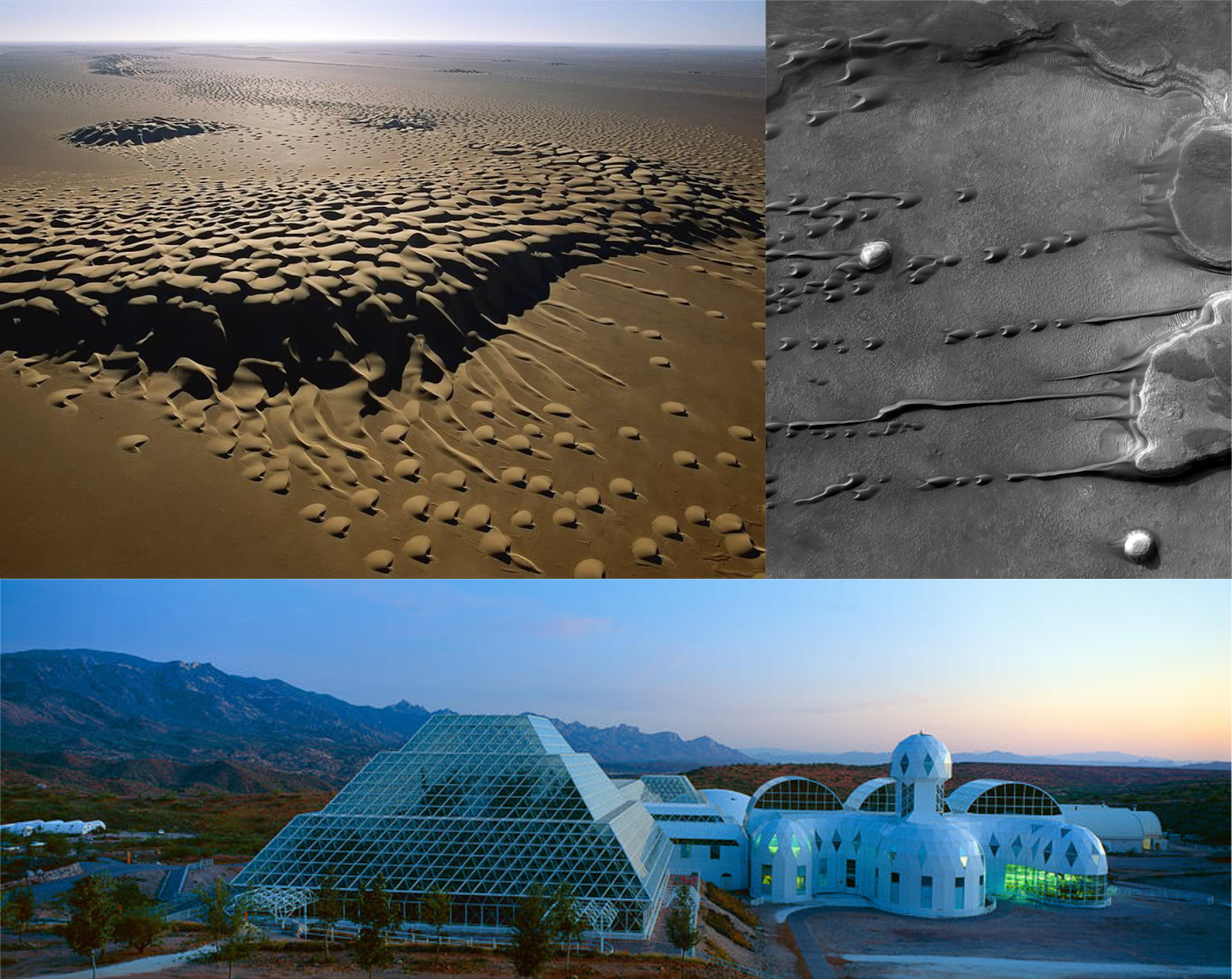
Images: Barchan dunes on Earth (top left) and on Mars (top right); Biosphere 2 near Oracle, Arizona (credits: George Steinmetz/ HiRISE, MRO, University of Arizona, NASA)

*

Call for Papers
Application deadline: April 15th  2019
(send presenter’s information, title and 150-word abstract to ocavbioarti@gmail.com)
Decisions : April 30th 2019

*

In the present day and age, space exploration can no longer be conceived merely as ‘rocket science’. Surely, aeronautic engineering, robotic probes and space telescopes continue to play an important role, and so does in-situ research by human astronauts who have conducted a number of experiments designed to advance scientific knowledge of life in extraterrestrial conditions. But space observation and exploration can now be framed in the emerging fields of astro- and exobiology – what life could be in non-Terrestrial environments–, and the perspective of human and non-human Terrestrial life to be established in outer space, on other planets, or in spacecraft. Think of NASA astronaut Don Pettit’s ‘space zucchini’, whose development he recorded in a popular public diary, or of the equally captivating micro-gravitational adventures of the jumping spiders or ‘spidernauts’ on board of the International Space Station!

But what remains insufficiently recognised is that our knowledge of outer space and its potential inhabitants is gained here on Earth, based on how we study our own planet and life that inhabits it, including our societies. Astrobiologists and planetary scientists are nowadays experimenting with elaborate, lab-based simulations of entire planets and are modeling hypothetical martian ecosystems and alien biospheres in ever more sophisticated ways. The Biosphere 2 facility in Arizona, which was conceived as an alternative Earth-like mini-planet, pioneered this trend. Beyond their laboratories, scientists conduct fieldwork in specific locations referred to as extreme environments or analogue sites, which serve as proxies for what might happen on planetary bodies elsewhere. Andean highland lakes thus become tools to comprehend early, ‘wet’ Mars for example. And the extremophile organisms that inhabit them are used to model alien life forms. These practices beg the general question: how does our Earth-centric perspective on the universe influences our sense of the living beyond Earth? In particular, is scientific creativity – the driver of science progress – enough to study life as it might be, and living in outer space as we will do it, enough? Is it to be enhanced with some form of scientific imagination, and what should that be?

The workshop proposes to address such fundamental questions by examining  practices of planetary modeling and analogue research from a social scientific perspective. For space exploration, at its most innovative, involves more than gathering new empirical data about the cosmos. It is not just about collating interesting observational discoveries, but also about reconsidering modern science’s set ways of imagining the cosmos. By focusing on the interface between rigorous observation and conceptual imagination, this workshop aims to trace the contours of an anthropology off Earth. The call for papers is open for anthropologists, STS scholars, historians and philosophers of science and, more generally, for all social scientists interested in outer space as well as for planetary scientists and astrobiologists interested in the conceptual and imaginative dimensions of space exploration.

vendredi 20 avril 2018

Journée d'études L'animisme aujourd'hui

Laboratoire d’Anthropologie Sociale
Équipe « Anthropologie de la vie et des représentations du vivant »
Projet La vie à l’œuvre
Projet IRIS – Origines et conditions d’apparition de la vie
Pépinière interdisciplinaire CNRS-PSL Domestication et fabrication du vivant
Labex TransferS

L'animisme aujourd'hui

Journée d’études organisée par 
Perig Pitrou & Joffrey Becker

Dans le cadre du séminaire 
Anthropologie de la vie et des représentations du vivant

Le 17 mai 2018
9h30 – 17h30

Collège de France – Salle 2
11 place Marcelin Berthelot
Paris

Inscription obligatoire sur : 

Dans Le totémisme aujourd’hui (1962), Claude Lévi-Strauss entreprend une réflexion critique autour d’une notion classique de l’anthropologie, afin de déterminer sa valeur heuristique pour la compréhension des sociétés humaines. Dans le même esprit, cette journée d’étude organisée par l’équipe « Anthropologie de la vie et des représentations du vivant » vise à engager une réflexion collective interdisciplinaire dans un domaine revitalisé par les travaux contemporains des anthropologues amazonistes. En s’interrogeant sur le statut de l’animisme dans le cadre d’un projet comparatiste d’anthropologie de la vie, un des objectifs est d’évaluer son rendement analytique, hors des sociétés traditionnelles, dans des enquêtes menées sur l’horticulture urbaine, les thérapeutiques néo-chamaniques, la robotique, le cinéma ou l’exobiologie.


Programme

9:30 
Accueil 

9:45
Perig Pitrou (CNRS – LAS – PSL) 
L’animisme aujourd’hui. La perspective de l’anthropologie de la vie 

10:15 
Martin Fortier (EHESS – PSL) 
L’animisme sans essence : âmes, maîtres et identité biologique chez les Pano d'Amazonie et au-delà 

11:00 
Pause 

11:30 
David Dupuis (Durham University – LAS) 
Les gringos deviendraient-ils animistes ? Rencontres avec le végétal dans un centre chamanique d'Amazonie péruvienne 

12:15 
Istvan Praet (University of Roehampton – Chercheur Invité IRIS-OCAV) 
Animisme & astrobiologie : Des laboratoires conceptuels 

13:00 
Pause 

14:00 
Émilie Letouzey (Université Toulouse Jean Jaurès – LISST – CAS) 
Animé, animer : exemples d’“animizumu” en contexte japonais 

14:45 
Teresa Castro (Université Sorbonne Nouvelle – Paris 3 – IRCAV) 
Un cinéma animiste ? De l’individualité technique à la subjectivité machinique de la caméra 

15:30 
Pause 

16:00 
Joffrey Becker (LAS – IRIS-OCAV – PSL) 
Devenons-nous animistes au contact des robots ? 

16:45 
Discussion générale