Social Anthropology - Robots, AI & Society
Affichage des articles dont le libellé est OCAV. Afficher tous les articles

jeudi 23 mai 2019

Anthropology Off Earth


ANTHROPOLOGY OFF EARTH
How Terrestrial Exploration and Scientific Imagination
Shape Our Relation to Outer Space and Extraterrestrial Life

4 June 2019
Collège de France
Salle 2
11, place Marcelin Berthelot
Paris 5e

5 June 2019
Observatoire de Paris
Salle du Conseil
77, Avenue Denfert-Rochereau
Paris 14e


Online registration required on: https://forms.gle/JchYSNiCUeDaPvty7


Organisers: Perig Pitrou (CNRS/Collège de France/Paris Sciences et Lettres University), Régis Ferrière (École Normale Supérieure/Paris Sciences et Lettres University & University of Arizona), Istvan Praet (University of Roehampton, London).

Organisers of the doctoral and post-doctoral session: Joffrey Becker (IRIS-OCAV/Paris Sciences et Lettres University), Elsa De Smet (IRIS-OCAV/Paris Sciences et Lettres University).

*

CONFERENCE PROGRAM

4 June 2019
Collège de France
Salle 2

Morning Session

9:30
Welcome

10am
Perig PITROU
LAS – IRIS-OCAV/Paris Sciences et Lettres University
Anthropology of Life, On Earth & Off Earth

10:40
Denis SIVKOV
Institute for Social Sciences / RANEPA Moscow
Space Exploration at Home: Amateur Cosmonautics in Contemporary Russia

11:20
Break

11:40
Aaron PARKHURST, David JEEVENDRAMPILLAI
University College London, NTNU
Making a Martian Feel at Home: Finding Humans on Mars Through Utopian Architecture

12:20
Roundtable
Familiarizing the Extraterrestial / Making our Planet Alien
Discussion led by
Istvan PRAET
University of Roehampton

1pm
Lunch Break

Afternoon Session

2:30
Elie DURING
Paris Nanterre University
Zero-G as Expanded Gravitational Experience
Scientific Imagination in Orbital Perspective

3:10
Istvan PRAET
University of Roehampton
The Ancient Earth as an Alien Planet
Astrobiological Models and the Installation of Discontinuities

3:50
Break

4:20
Luis CAMPOS
University of New Mexico
Soviet Astrobotany: Early Experiments in Earthly Analogues for Martian Life

5pm
Roundtable
New Ecologies
Discussion led by
Régis FERRIÈRE
ENS – UMI Iglobes

6pm
Cocktail Reception
Lunch Seminar College de France

*
5 June 2019
Observatoire de Paris
Salle du conseil

Keynote Session

9:30am
Welcome

9:45
Valerie OLSON
UC Irvine
Making Sense of Post-terrestrial Ecosystems

10:45
Break

11am
Lisa MESSERI
Yale University
Outer Space on Earth: Terrestrial Analogues for Imagining Other Worlds

12pm
General discussion
 Led by
Perig PITROU, Ludovic JULLIEN, Stéphane MAZEVET
LAS – IRIS-OCAV/Paris Sciences et Lettres University, SU – ENS/Paris Sciences et Lettres University, Observatoire de Paris/Paris Sciences et Lettres University

12:35
Lunch Break

Doctoral & Post Doctoral Session

2:15
Elsa DE SMET, Joffrey BECKER
IRIS-OCAV/Paris Sciences et Lettres University
Introduction

2:30
Tamara ALVAREZ
The New School for Social Research
The Moon as Nature

2:45
Benjamin POTHIER
Plymouth University / The Explorers Club
Astronauts On I.C.E: Lessons Learnt From Field Research During Analog Astronaut Trainings and Life Experiences in [I.C.E] Isolated, Confined and Extreme Environments

3pm
Gabriela RADULESCU
Humboldt University of Berlin / University of Iceland
The Outer Space Imaginary Shaped During the Cold War by the Soviet Project of Communication with Extraterrestrial Intelligence (CETI)

3:15
Julien WACQUEZ
EHESS Paris / CEFRES
How Does Science Fiction Literature Shape Scientific Imagination?

3:30
Break

3:45
Valentina MARCHESELLI
University of Milan, La Statale
Welcome to planet Mars: Analogy-making and space exploration

4pm
Meredith ROOT-BERNSTEIN
Instituto de Ecología y Biodiversidad, AgroParisTech, Center of Applied Ecology and Sustainability, Santiago, Chile
Things That Are Not Alive, But That May Be Alive, in A Certain Way

4:15
Siri LAMOUREAUX, James MERRON
Max Planck Institute, University of Basel
Ghana’s Radio Astronomy Observatory and the Scientific Imagination

4:30
Alexander TAYLOR
University of Cambridge
Space Weather Security in the Data Centre Industry

4:45
General Discussion
Led by
Istvan PRAET, Régis FERRIÈRE, Elsa DE SMET, Joffrey BECKER
University of Roehampton, ENS-UMI Iglobes, IRIS-OCAV/Paris Sciences et Lettres University

mercredi 6 mars 2019

Anthropology Off Earth - Call for papers


Anthropology Off Earth
How Terrestrial Exploration and Scientific Imagination 
Shape Our Relation to Outer Space and Extraterrestrial Life

Paris, 4-5 June 2019 (Collège de France / Observatoire de Paris)


Organisers: Perig Pitrou (CNRS/Collège de France/Paris Sciences et Lettres University), Régis Ferrière (École Normale Supérieure/Paris Sciences et Lettres University & University of Arizona), Istvan Praet (University of Roehampton, London).

Organisers of the doctoral and post-doctoral session: Joffrey Becker (IRIS-OCAV/Paris Sciences et Lettres University), Elsa De Smet (IRIS-OCAV/Paris Sciences et Lettres University).

Keynote speakers: Valerie Olson (UC Irvine), Lisa Messeri (Yale University).

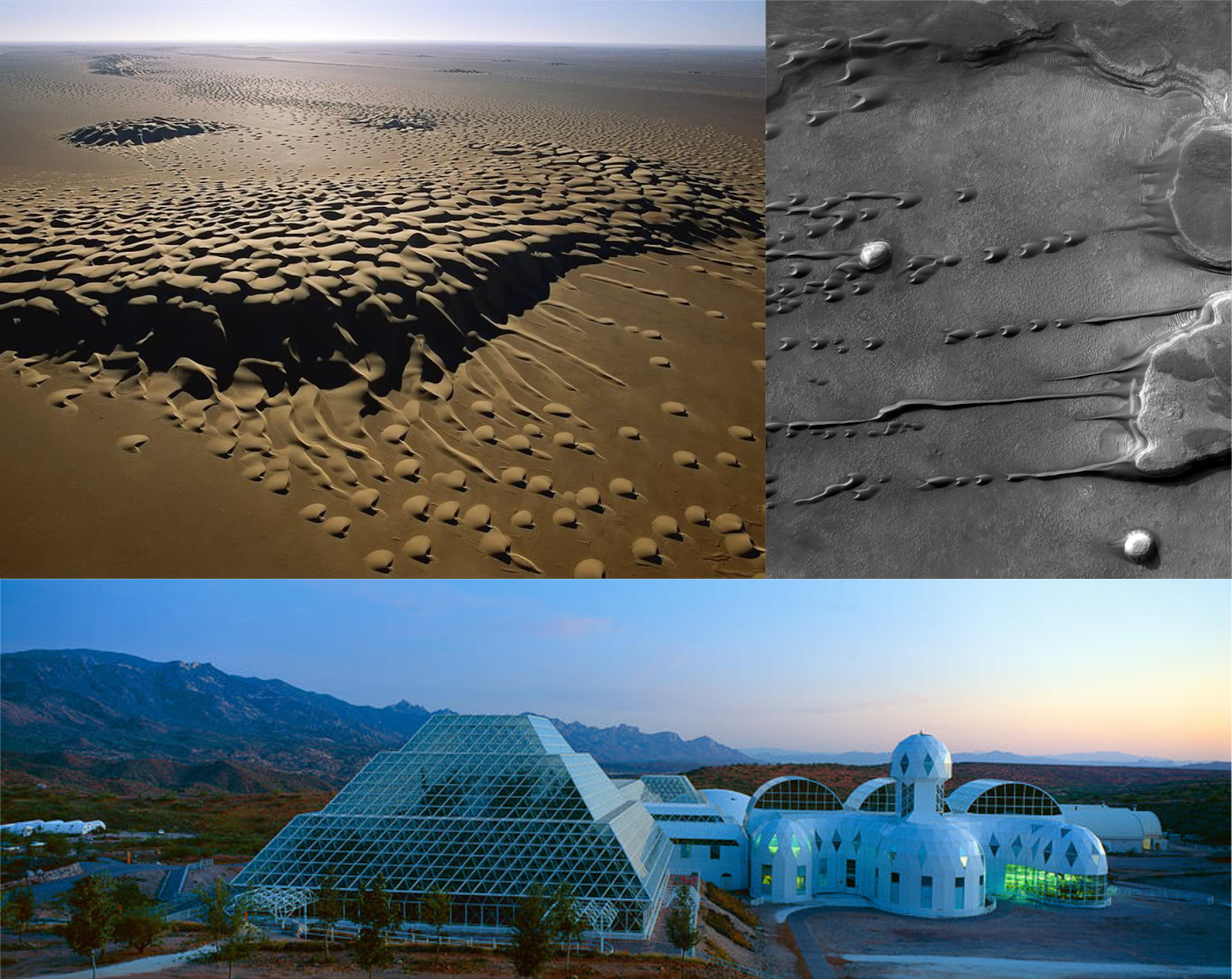
Images: Barchan dunes on Earth (top left) and on Mars (top right); Biosphere 2 near Oracle, Arizona (credits: George Steinmetz/ HiRISE, MRO, University of Arizona, NASA)

*

Call for Papers
Application deadline: April 15th  2019
(send presenter’s information, title and 150-word abstract to ocavbioarti@gmail.com)
Decisions : April 30th 2019

*

In the present day and age, space exploration can no longer be conceived merely as ‘rocket science’. Surely, aeronautic engineering, robotic probes and space telescopes continue to play an important role, and so does in-situ research by human astronauts who have conducted a number of experiments designed to advance scientific knowledge of life in extraterrestrial conditions. But space observation and exploration can now be framed in the emerging fields of astro- and exobiology – what life could be in non-Terrestrial environments–, and the perspective of human and non-human Terrestrial life to be established in outer space, on other planets, or in spacecraft. Think of NASA astronaut Don Pettit’s ‘space zucchini’, whose development he recorded in a popular public diary, or of the equally captivating micro-gravitational adventures of the jumping spiders or ‘spidernauts’ on board of the International Space Station!

But what remains insufficiently recognised is that our knowledge of outer space and its potential inhabitants is gained here on Earth, based on how we study our own planet and life that inhabits it, including our societies. Astrobiologists and planetary scientists are nowadays experimenting with elaborate, lab-based simulations of entire planets and are modeling hypothetical martian ecosystems and alien biospheres in ever more sophisticated ways. The Biosphere 2 facility in Arizona, which was conceived as an alternative Earth-like mini-planet, pioneered this trend. Beyond their laboratories, scientists conduct fieldwork in specific locations referred to as extreme environments or analogue sites, which serve as proxies for what might happen on planetary bodies elsewhere. Andean highland lakes thus become tools to comprehend early, ‘wet’ Mars for example. And the extremophile organisms that inhabit them are used to model alien life forms. These practices beg the general question: how does our Earth-centric perspective on the universe influences our sense of the living beyond Earth? In particular, is scientific creativity – the driver of science progress – enough to study life as it might be, and living in outer space as we will do it, enough? Is it to be enhanced with some form of scientific imagination, and what should that be?

The workshop proposes to address such fundamental questions by examining  practices of planetary modeling and analogue research from a social scientific perspective. For space exploration, at its most innovative, involves more than gathering new empirical data about the cosmos. It is not just about collating interesting observational discoveries, but also about reconsidering modern science’s set ways of imagining the cosmos. By focusing on the interface between rigorous observation and conceptual imagination, this workshop aims to trace the contours of an anthropology off Earth. The call for papers is open for anthropologists, STS scholars, historians and philosophers of science and, more generally, for all social scientists interested in outer space as well as for planetary scientists and astrobiologists interested in the conceptual and imaginative dimensions of space exploration.

lundi 5 novembre 2018

Biosphere 2 - Feb 2018


Dr. Katerina Dontsova, Aaron Bugaj, Dr. Gene Giacomelli and Katie Morgan kindly accepted to tell us about the state of the art science done at UA Biosphere 2. 

Short-film made by Joffrey Becker, in collaboration with Perig Pitrou & Istvan Praet thanks to the support of PSL Research University program IRIS-OCAV/Bioarti and CNRS-UA UMI IGlobes.

PRÉSENCES EXTRATERRESTRES - Saison 2


La saison 1 du cycle « PRÉSENCES EXTRATERRESTRES » proposait une série de films sur la diversité des formes de vie extraterrestres qui pourraient survenir sur Terre.

Diversité des formes de vie en science-fiction

L’astrophysicien Roland Lehoucq, l’anthropologue Perig Pitrou et le paléontologue Jean-Sébastien Steyer ont savamment concocté le cycle de la saison 2, avec 8 films programmés jusqu’en juin 2019.

Ils nous proposent de suivre ce qui se produit lorsque des humains s’aventurent au-delà des limites de l’atmosphère : pour se placer en orbite géostationnaire, se poser sur la Lune ou sur Mars, voire pour explorer de nouvelles galaxies.

Que ce soit pour fuir un monde devenu invivable, coloniser d’autres environnements ou mieux connaître les exoplanètes disséminées dans l’Univers, les raisons de s’arracher à la pesanteur terrestre ne manquent pas.

Dans tous les cas, les humains doivent réaliser des prouesses technologiques et adapter leurs corps afin d’assurer le bon fonctionnement de processus biologiques fondamentaux (respiration, mouvement, alimentation, sommeil).

La vie des organismes se révèle donc indissociable des écosystèmes, naturels ou anthropisés (vaisseaux spatiaux, bases lunaires ou martiennes) au sein desquels ils évoluent, dans des couplages humains/machines inédits.

La mise en scène d’évènements extraordinaires, autant que la description des activités quotidiennes, montrent que, plus largement, cette expérience met à l’épreuve la capacité des humains à vivre seuls… ou en groupe. Par-delà les questions biologiques et technologiques, l’exploration spatiale soulève donc toujours des questions sociales et politiques.

Un cycle de 8 films-débats

En compagnie d’écrivains, d’astrophysiciens, de chercheurs en sciences physiques, en sciences naturelles et en sciences humaines et sociales, ce cycle de 8 films-débats invite à réfléchir à ce que sont, ou pourraient être, des vies humaines dans l’espace.

Les personnages de ces films survivront-ils ? 
Rencontreront-ils des formes de vie non-humaines ? 
Ce cycle est organisé en partenariat avec Sciences et Avenir.

vendredi 20 avril 2018

Journée d'études L'animisme aujourd'hui

Laboratoire d’Anthropologie Sociale
Équipe « Anthropologie de la vie et des représentations du vivant »
Projet La vie à l’œuvre
Projet IRIS – Origines et conditions d’apparition de la vie
Pépinière interdisciplinaire CNRS-PSL Domestication et fabrication du vivant
Labex TransferS

L'animisme aujourd'hui

Journée d’études organisée par 
Perig Pitrou & Joffrey Becker

Dans le cadre du séminaire 
Anthropologie de la vie et des représentations du vivant

Le 17 mai 2018
9h30 – 17h30

Collège de France – Salle 2
11 place Marcelin Berthelot
Paris

Inscription obligatoire sur : 

Dans Le totémisme aujourd’hui (1962), Claude Lévi-Strauss entreprend une réflexion critique autour d’une notion classique de l’anthropologie, afin de déterminer sa valeur heuristique pour la compréhension des sociétés humaines. Dans le même esprit, cette journée d’étude organisée par l’équipe « Anthropologie de la vie et des représentations du vivant » vise à engager une réflexion collective interdisciplinaire dans un domaine revitalisé par les travaux contemporains des anthropologues amazonistes. En s’interrogeant sur le statut de l’animisme dans le cadre d’un projet comparatiste d’anthropologie de la vie, un des objectifs est d’évaluer son rendement analytique, hors des sociétés traditionnelles, dans des enquêtes menées sur l’horticulture urbaine, les thérapeutiques néo-chamaniques, la robotique, le cinéma ou l’exobiologie.


Programme

9:30 
Accueil 

9:45
Perig Pitrou (CNRS – LAS – PSL) 
L’animisme aujourd’hui. La perspective de l’anthropologie de la vie 

10:15 
Martin Fortier (EHESS – PSL) 
L’animisme sans essence : âmes, maîtres et identité biologique chez les Pano d'Amazonie et au-delà 

11:00 
Pause 

11:30 
David Dupuis (Durham University – LAS) 
Les gringos deviendraient-ils animistes ? Rencontres avec le végétal dans un centre chamanique d'Amazonie péruvienne 

12:15 
Istvan Praet (University of Roehampton – Chercheur Invité IRIS-OCAV) 
Animisme & astrobiologie : Des laboratoires conceptuels 

13:00 
Pause 

14:00 
Émilie Letouzey (Université Toulouse Jean Jaurès – LISST – CAS) 
Animé, animer : exemples d’“animizumu” en contexte japonais 

14:45 
Teresa Castro (Université Sorbonne Nouvelle – Paris 3 – IRCAV) 
Un cinéma animiste ? De l’individualité technique à la subjectivité machinique de la caméra 

15:30 
Pause 

16:00 
Joffrey Becker (LAS – IRIS-OCAV – PSL) 
Devenons-nous animistes au contact des robots ? 

16:45 
Discussion générale

vendredi 8 décembre 2017

BIOCOSMOS — Doctoral and Post-Doctoral Session

https://flic.kr/p/9Jvz3H

CNRS-ENS-UA International Research Center iGLOBES
Paris Sciences & Lettres Research University / Interdisciplinary Program on Origin and Conditions of Appearance of Life

“BIOCOSMOS – Our Sense of Place, Our Sense of Life in the Universe”
Workshop organized by Dr. Perig Pitrou (Collège de France/PSL Research University, Paris), Dr. Istvan Praet (University of Roehampton, London), Dr. Regis Ferriere (University of Arizona and ENS/PSL Research University, Paris) and Dr. Kevin Bonine (University of Arizona) 

February 1-2, 2018, at Biosphere 2 – Oracle (AZ)

Doctoral and Post-Doctoral Session
Organized by Dr. Joffrey Becker (Collège de France/PSL Research University Paris)

Call for participation

Since ecology has been defined by Ernst Haeckel (1866) as the science of the interactions between living organisms and their environments (a science of the oikos), the boundaries between living and non-living systems have constantly been blurred. The notion of homeostasis (Cannon, 1932) or the feedback loops (Rosenblueth, Wiener & Bigelow, 1947) have led to consider in a very similar way phenomenons that are related to both the description of life and the production of artifacts. These notions progressively conducted to the emergence of cybernetics, a science of the structures that describes the dynamics of self-organized systems and simultaneously participates in the conception of a new kind of machines.
If James Lovelock provocatively wrote that we could one day imagine that our engineered systems could be as subtle and versatile than their biological equivalents (Lovelock, 1979:77), systems appear in a movement that metaphorically mechanizes nature and brings machines to a form of protolife. They constitute a link between life and techniques.
The aim of this session is to explore this crossed space that the notion of system seems to create.  Opened to Ph.D students and post-doctoral researchers in social and natural sciences, this session will focus on issues directly related to cybernetic systems, considering them as both a mean to represent ecosystems emerging in the universe, but also as a mean to construct artificial devices where terrestrial life can survive outside the Earth. We will more specifically focus on the question: What fundamental elements and which interactions allow us to consider that a world (natural or artificial) can be inhabited, a world in which life can develop and maintain itself? We will thus try to better understand how cybernetic systems, through the mediation of theoretical or real machines, invite us to consider the complex (and culturally informed) entanglements of life and techniques.

Cannon Walter B., 1932, The Wisdom of the Body, New-York, W.W. Norton & Company, inc
Haeckel Ernst, 1866, Generelle Morphologie der Organismen, 2 vol., Berlin, G. Reimer
Lovelock James, 1993 [1979], La terre est un être vivant, L'hypothèse Gaïa, Paris, Flammarion
Rosenblueth Arturo, Wiener Norber, Bigelow Julian, 1943, “Behavior, Purpose and Teleology”, Philosophy of Science, 10(1), 18-24

Submission Information

Candidates must precise whether they want to do an oral presentation or whether they prefer to present a poster.

Submissions must contain:
- The name of the presenter, affiliations, email address
- The title of the presentation / poster
- An abstract (150-300 words)
- If applicable, a list of selected publications, relevant to the proposed topic of the talk
- A short curriculum / resume

Submissions must be sent before December 20th to: ocavbioarti@gmail.com

Notification regarding acceptance of submissions will be sent by email during the first week of January.

UMI iGlobes will reimburse part of the travel to Tucson, and cover two nights at Biosphere 2 and meals during the workshop.


jeudi 19 octobre 2017

PRÉSENCES EXTRATERRESTRES - DIVERSITÉ DES FORMES DE VIE EN SCIENCE-FICTION


PRÉSENCES EXTRATERRESTRES
DIVERSITÉ DES FORMES DE VIE EN SCIENCE-FICTION
8 FILMS-DÉBATS

Programmation proposée par Roland Lehoucq, Perig Pitrou & Jean-Sébastien Steyer
Dans le cadre du projet Paris Sciences et Lettres
ORIGINES ET CONDITIONS D’APPARITION DE LA VIE

NOVEMBRE 2017 – JUIN 2018

Cinéma Le Grand Action
5, rue des Écoles, Paris 5e

*

15 novembre 2017, 20h00 
RENCONTRES DU TROISIÈME TYPE
S. Spielberg
Séance suivie d’un cocktail
Discussion animée par R. Lehoucq (CEA), F. Marchis (SETI Institute) & S. Mazevet (Observatoire de Paris)

13 décembre 2017, 20h00
LE JOUR OÙ LA TERRE S’ARRÊTA
R. Wise
Discussion animée par P. Pitrou (CNRS) & W. Stoczkowski (EHESS)

17 janvier 2018, 20h00
THE THING
J. Carpenter
Discussion animée par B. Le Maître (Univ. Paris Nanterre) & F. Moutou (ANSES)

14 février 2018, 20h00
PACIFIC RIM 
G. del Toro
Discussion animée par R. Lehoucq (CEA) & J.-S. Steyer (CNRS/MNHN)

14 mars 2018, 20h00
DISTRICT 9
N. Blomkamp
Discussion animée par A. Musset (EHESS) & J.-S. Steyer (CNRS/MNHN)

11 avril 2018, 20h00
UNDER THE SKIN
J.Glazer
Discussion animée par É. Bapteste (CNRS) & P. -L. Patoine (Univ. Sorbonne-Nouvelle)

16 mai 2018, 20h00
MIDNIGHT SPECIAL
J. Nichols
Discussion animée par A. Esquerre (CNRS) & P. Pitrou (CNRS)

26 juin 2018, 20h00
PREMIER CONTACT
D. Villeneuve
(entrée libre, sur réservation)
Séance suivie d’un cocktail,
proposée en partenariat avec le Cycle Univers Convergents organisé par l’Institut Henri Poincaré
Discussion animée par R. Lehoucq (CEA) & V. Vapnarsky (CNRS)